Exploring New Frontiers With the Quarterly Workforce Indicators
The “space economy” continues to soar and younger workers are fueling the industry’s upward trajectory.
The extraterrestrial industry accounted for $142.5 billion (0.5%) of U.S. GDP in 2023, combining activities from the Manufacturing, Transportation, and Information sectors, including Satellite Telecommunications and Guided Missile and Space Vehicle Manufacturing. The U.S. Census Bureau released today the first ever Quarterly Workforce Indicators (QWI) at the national industry level. These data will allow users to view and download economic indicators such as employment, job creation, earnings and other measures of employment flows for six-digit North American Industry Classification System (NAICS) codes.
This level of detail opens new paths for analyzing parts of the economy that cross industry groups and provides unprecedented detail on the inner workings of our economy. The powerful new data enable us to boldly go where no one has gone before when examining this workforce of the future.
New Hires in the Space Economy Are Increasingly Younger
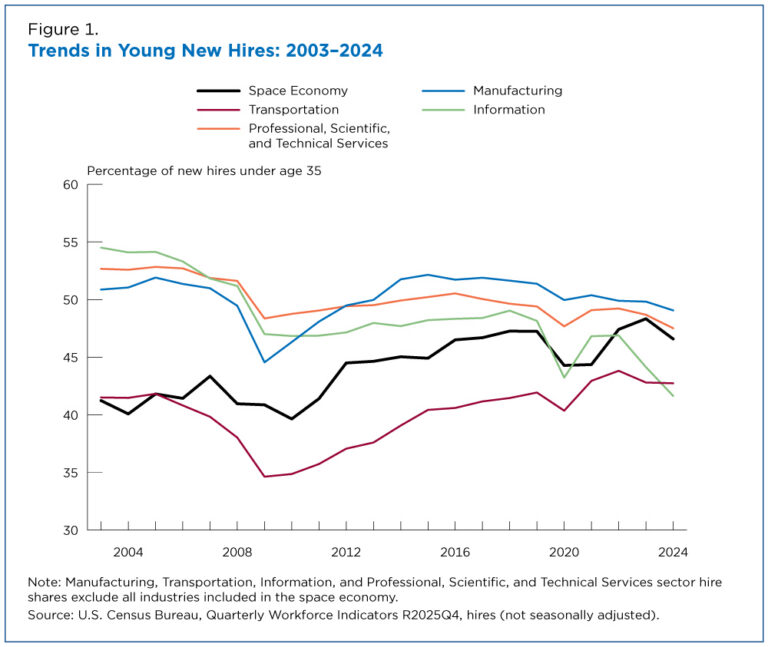
In 2024, nearly one-half of all new hires in the Space Economy cluster were under the age of 35. This share, while down relative to the previous year, remained part of an upward trend in the hiring of young talent for the space workforce.
The prevalence of these young workers is on par with that in the Professional, Scientific, and Technical Services sector, a distinct part of the economy employing similar workers.
Over the past decade, growth in the share of young new hires in the space economy (3%) far exceeded that of the nonspace components of the Manufacturing (-5%) and Information sectors (-13%). They are also consistently younger than new hires in the nonspace industries within the Transportation sector.
The growth among young workers in space fields also corresponded with an increase in worldwide commercial space activity in recent years. Revenue from private sector space activity in 2023 surpassed $445 billion, 5% higher than in 2022.
More Young Workers Are Employed in Most Areas of the Space Economy
The new detailed QWI data allow for industry-level tabulations, including for subgroups, a level of specificity not previously possible with this dataset.
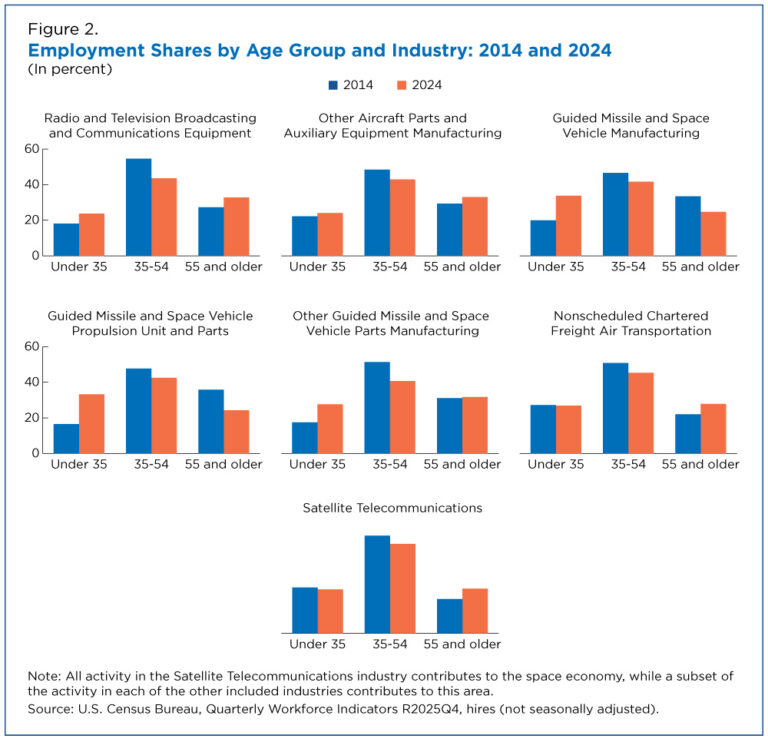
Granular information on workforce indicators empowers policymakers and business leaders to more deeply understand the dynamics of highly specialized labor markets. For example, we now know that the share of workers under the age of 35 has increased over the last 10 years in five of the seven industries that make up the space economy.
At the same time, workers ages 35-54 are less prevalent in each of these industries but remain the largest segment of the workforce.
This decrease in the middle of the age distribution has not led to a corresponding increase in employment shares among the oldest workers (age 55 and over). Their employment share increased from 19% in 2014 to 25% in 2024 in the Satellite Telecommunications industry but decreased from 33% to 25% in the Guided Missile and Space Vehicle Manufacturing industry (Figure 2).
The net result across the space economy is a shift toward a younger workforce over the past decade — the share of workers under 35 increased 32% while the share over 55 increased by less than 1%.